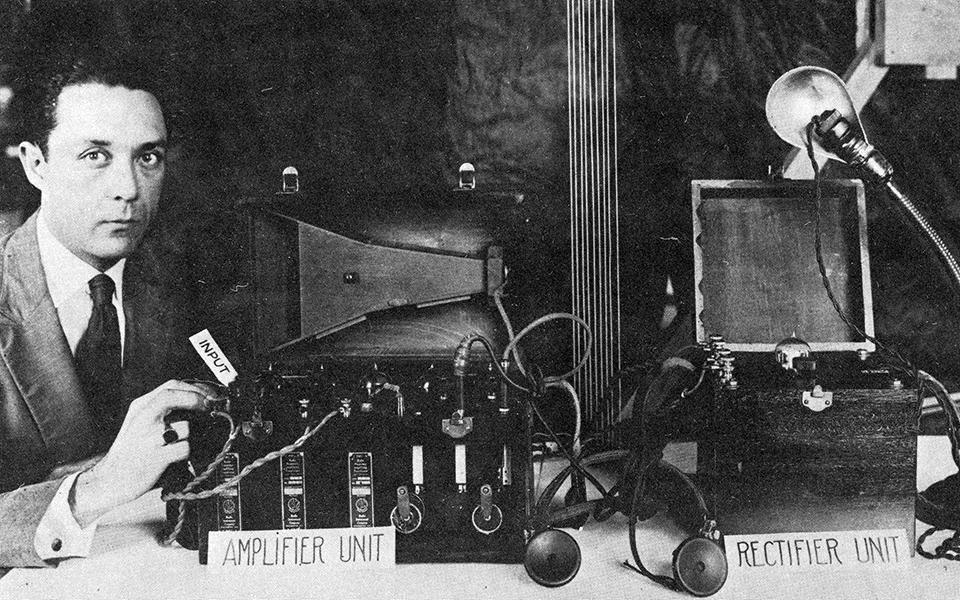
The concept of radio had existed for decades, and if you've scrolled through a radio dial or a digital radio, you've used one of the most useful tools today. Early radio was ultimately discombobulated, you couldn't pick a station, you could just hear which channel was the loudest from where you were currently at.
When you look up who created the first radio with tuners, the first name that pops up is Guglielmo Marconi, and while yes he made an extreme impact on tuners and gets the majority of credit for this, there were many parties involved with the process of the development of this invention. Marconi's famous "Four Sevens" patent (No. 7,777) in 1900 was what set the plan into motion. It utilized a system of adjustable capacitors and inductors to ensure that transmitters and receivers were on the same frequency. This was also called syntonic telegraphy, and it's the reason why we don't have multiple stations overlapping each other.
Sir Oliver Lodge created the initial syntonic patent years before Marconi produced his own. John Stone Stone was behind the math of selective tuning. Nikola Tesla was also involved with this invention,
and it was so impactful that the Supreme Court actually overturned a few of Marconi's patent claims decades later and recognized Tesla's major contributions.
The technology was still rough around the edges until Karl Ferdinand Braun invented inductive coupling. Marconi's earlier systems died out fast, so inductive coupling separated the antenna from the transmitter's circuit and it created a powerful and steady signal that could be tuned for long distances. It was so big that Braun and Marconi shared a Nobel Prize in Physics together in 1909.
 Something that I discovered while researching more about the people who worked on this invention was John L. Reinartz. He was responsible for taking what the others worked hard on and getting it out to the public. Tuning in the 1920s was something so sensitive that if you breathed wrong, you ran the risk of knocking the channel off. Reinartz created the Reinartz Tuner, which simplified the regenerative circuit so that people could tune in to any station with one or two dials. He didn't keep his design to himself, he published his designs in radio magazines like QST, which allowed hundreds and thousands of people to build their own clear sounding radios right from home. He later went to become a shortwave radio developer and helped develop radar technology during WWII.
Without the people that played their various roles in making this invention what it is today, we wouldn't have as high quality tech that we do including wifi. Tuning made selecting frequencies easier and it's now like an organized library of sound waves. Today, we celebrate the history of this impactful invention on what is called World Radio Day, which is on February 13th every year. It's a day to remind us behind the clear frequencies that give us the stations that we enjoy, were centuries of inventors who worked to make this possible.


No comments:
Post a Comment